
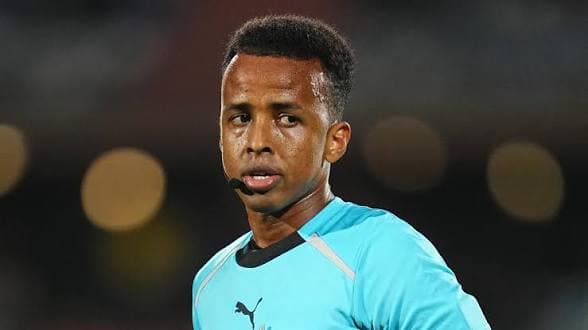
Africa's Best Referee Was Barred From the World Cup He Earned the Right to Officiate. The US Said "Vetting Concerns." No Further Explanation Was Given.
Omar Abdulkadir Artan, 34, was named Africa's Best Referee in 2025 and was one of 52 officials selected by FIFA for the 2026 World Cup. He arrived at Miami International Airport on June 6. He was turned around and sent back to Istanbul. US authorities cited vetting concerns. No further explanation has been given. FIFA said it is powerless to override the decision. Somalia is on Trump's travel ban list.
Africa's Best Referee Was Barred From the World Cup He Earned the Right to Officiate. The US Said "Vetting Concerns." No Further Explanation Was Given.
Omar Abdulkadir Artan spent years building a refereeing career that took him from Somalia's domestic league to the highest stages of African football. He refereed at the Africa Cup of Nations. He made history as the first Somali to officiate a CAF Champions League final. In November 2025, the Confederation of African Football named him the continent's best referee. In April 2026, FIFA confirmed him as one of 52 officials selected to referee at the 2026 World Cup in Canada, Mexico, and the United States.
On Saturday, June 6, he arrived at Miami International Airport. He did not make it through. He was placed on a return flight to Istanbul without being told why.
As of Monday, June 8, he is no longer part of the World Cup. The tournament begins on Thursday.
What US Authorities Said
US Customs and Border Protection confirmed the incident in a statement released on Monday.
"During processing, the traveler underwent additional inspection, a routine part of CBP's inspection process when officers need to verify information or determine admissibility," the statement said. "Following inspection, the traveler, a referee for the FIFA World Cup, was determined to be inadmissible due to vetting concerns and was denied entry."
CBP did not name Artan directly in its statement, but FIFA subsequently confirmed he was the individual referenced. No further explanation of what constituted the "vetting concerns" was provided. No charges were made. No legal process was initiated. He was simply turned around.
The Department of Homeland Security separately confirmed to Al Jazeera that Artan was denied entry after arriving in South Florida, describing him as having been "determined to be inadmissible due to vetting concerns."
Neither DHS nor CBP elaborated on what information triggered that determination or whether it could be reviewed or appealed.
What FIFA Said
FIFA issued a formal statement confirming Artan's removal from the tournament roster.
"FIFA can confirm that match official Omar Abdulkadir Artan will be unable to train and officiate at the FIFA World Cup 2026 after he was denied entry into the United States," a FIFA spokesperson told AFP.
FIFA made clear it had no authority to challenge or reverse the decision. "FIFA is not involved in host country immigration processes, including visa adjudications, and has been informed by authorities that Mr Artan's status will not be changed at present. In line with previous FIFA events, a host government ultimately determines who receives a visa and who is admitted into their country."
FIFA did not announce a direct replacement. It was unclear as of June 8 whether a new referee would be added to the roster or whether the matches Artan was assigned to cover would be redistributed among the remaining 51 officials. Referee assignments are not publicly announced until 24 to 48 hours before each match.
It is worth noting that FIFA awarded President Donald Trump its inaugural peace prize last year.
What Somalia Said
Ciise Aden Abshir, a senior adviser to Somalia's Ministry of Youth and Sports and a former Somalia national team captain, spoke to AFP and Al Jazeera about the decision.
"Omar Artan is among Africa's most respected referees and deserves the support of the entire football community," Abshir said. "Denying him entry to the United States and preventing him from officiating scheduled matches harms not only him personally but also undermines football's commitment to fairness, merit, and the spirit of fair play."
Abshir confirmed that Artan had a valid US visa at the time of his arrival in Miami. The diplomatic passport he carried was issued with the assistance of the Somali Embassy in Nairobi, Kenya, according to earlier reporting, provided specifically to ease previous visa-related difficulties he had encountered.
Somalia's President Hassan Sheikh Mohamud had praised Artan in April 2026 following his historic selection as the first Somali to be confirmed for a World Cup. "I commend the effort, professionalism, and integrity shown by referee Omar, as he has become a symbol of inspiration for the new generation of Somalis," the President said at the time.
What Artan Himself Said
Artan released a personal statement on Monday that was notably measured given the circumstances.
"Despite the circumstances, I am in a positive mood and I am focused on the next challenges in my refereeing career," he said. "I would like to thank FIFA and CAF for all their support and I promise to keep my refereeing levels up as I concentrate on the future. I want to thank the football family for their messages and wish my colleagues all the best success during the World Cup and I look forward to joining them again in future competitions."
He did not make any comment about the US government or the circumstances of his denial.
The Travel Ban Context
Somalia is included on the list of countries subject to travel restrictions introduced by the Trump administration. President Trump has made public statements about Somali nationals on multiple occasions during his current term.
The travel ban creates a legal framework in which Somali passport holders face elevated scrutiny at US points of entry regardless of the purpose of their visit, the credentials they carry, or the processes they have undergone. Artan had a valid US visa and a diplomatic passport. Neither was sufficient.
The Council on American-Islamic Relations condemned the decision on Monday. CAIR Deputy Director Edward Ahmed Mitchell told Al Jazeera: "Our nation should not ban anyone from our shores simply because of their race or their ethnicity. That is especially true of a coach or referee or anyone else coming to participate in the World Cup. Somali visitors go through the same vetting process that other visitors go through, and once someone has gone through that thorough vetting process, there is no reason to ban them from our country simply because of their nationality. Doing so is an affront to our values and the law."
The US government has not publicly responded to CAIR's statement.
Who Artan Is and What He Had Already Achieved
Omar Abdulkadir Artan was born in Mogadishu in 1992. He became a FIFA-listed referee in 2018, operating initially in Somalia's domestic league before rising through the continental ranks.
In January 2024, he made history as the first Somali to officiate at the Africa Cup of Nations, handling the Group E match between Tunisia and Namibia in Algeria.
In May 2026, weeks before his World Cup denial, he made history again as the first Somali to referee a CAF Champions League final, officiating the second leg between AS FAR of Morocco and Mamelodi Sundowns of South Africa at the Prince Moulay Abdallah Stadium in Rabat.
In November 2025, CAF named him the best male referee on the African continent for 2025.
He was one of 52 referees FIFA selected for the 2026 World Cup, one of nine African officials in the group and the only representative from Sub-Saharan Africa among the centre referees. His selection had been described by Somalia's football community as one of the most significant milestones in the country's sporting history, arriving after decades of conflict had limited Somalia's participation in international football at every level.
FIFA had previously stated in the lead-up to the tournament that a visa issue involving Artan had been "fully resolved" and that he "would be available to officiate at the FIFA World Cup." That statement was rendered inaccurate by the events of June 6.
The Broader Question
The 2026 FIFA World Cup is being co-hosted by three nations: Canada, Mexico, and the United States. The US is the primary host of the knockout rounds and the final. It is the first World Cup to be held across three countries and the first to feature 48 teams and 104 matches.
The entry of 32 team delegations, thousands of support staff, tens of thousands of media representatives, and millions of international fans requires the US to process visa and entry applications from nationals of virtually every country on earth. Several of those countries are on the Trump administration's travel ban list.
Artan's case is the first publicly confirmed instance of a tournament official being denied entry. Whether other officials, players, journalists or fans from travel-ban-listed countries face similar situations as the tournament progresses is a question that FIFA, the host cities, and human rights organisations are now actively monitoring.
FIFA has said it has no authority over host country immigration decisions. That position is legally accurate but has drawn criticism from football observers who argue the organisation should have done more to secure ironclad entry guarantees for all confirmed tournament officials before awarding hosting rights.
The World Cup begins on Thursday. Artan will not be there.
Comments (0)
Leave a Comment
No comments yet. Be the first to share your thoughts!
Related News
 Sports

Never Miss a Story
Get the latest breaking news and exclusive content delivered straight to your inbox.