
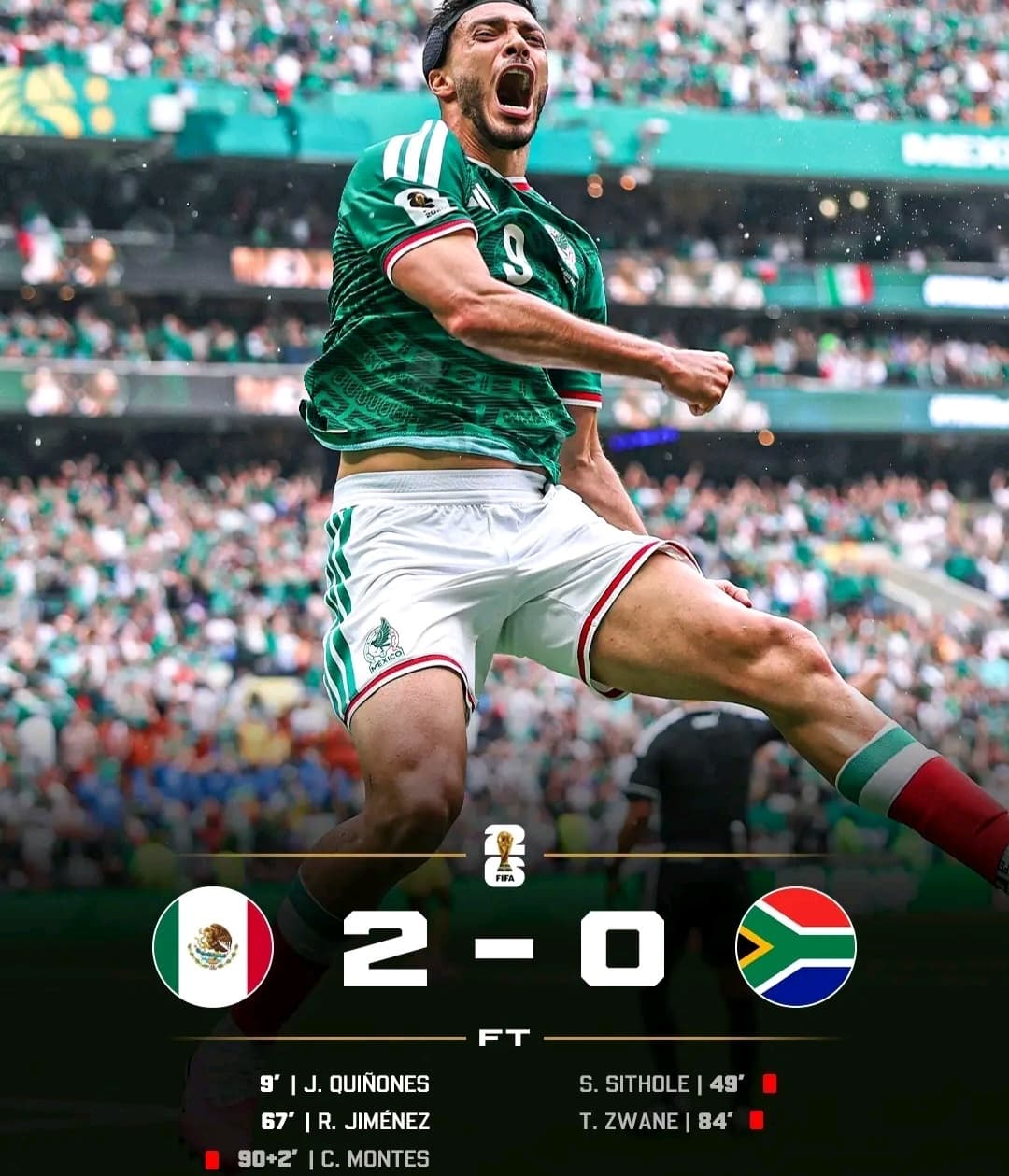
Mexico 2-0 South Africa. Three Red Cards. And Half of Africa Was Cheering for the Wrong Team — Here Is Why.
Mexico beat South Africa 2-0 at the Estadio Azteca to open the 2026 World Cup. It was a historic match: two goals, three red cards, the first time South Africa played a World Cup game since they hosted in 2010. But the story that has consumed African social media is not the result. It is the millions of Nigerians, Ghanaians, Kenyans and other Africans who watched their continental representative lose and celebrated.
Mexico 2-0 South Africa. Three Red Cards. And Half of Africa Was Cheering for the Wrong Team — Here Is Why.
When Teboho Mokoena received a yellow card in the 17th minute of Thursday's opening match of the 2026 FIFA World Cup, the moment barely registered beyond Estadio Azteca in Mexico City. By the time Teboho Zwane received South Africa's first red card in the 84th minute, followed by a second red for Nkosinathi Sibisi and then an additional dismissal for Mexico's César Montes that turned the closing minutes into chaos, the match had already made history.
But the bigger story was happening on screens across the African continent.
In Lagos. In Accra. In Nairobi. In Dakar. Nigerians, Ghanaians, Kenyans and other Africans watched South Africa, their continental representative, collapse at the world's biggest sporting stage. And millions of them celebrated it.
When the final whistle blew at the Estadio Azteca, the explosion of celebration across West African social media was instant, ruthless, and deeply personal. To an outside observer, the relentless trolling from Ghanaian and Nigerian fans looked like standard football banter mocking Bafana Bafana's disciplinary collapse. But the digital response stems from a far more painful reality: the severe wave of anti-migrant protests and xenophobic violence that recently forced fellow Africans to flee South Africa for their lives.
This is that story.
The Match Itself
The 2026 FIFA World Cup opened with a ceremony that was as theatrical as anything the tournament has produced. Shakira performed. Tyla performed. Burna Boy performed. Alejandro Fernández performed. The Estadio Azteca, the same ground where Diego Maradona scored the Hand of God in 1986 and where Pele lifted the Jules Rimet Trophy in 1970, roared.
Then the football began.
Mexico, co-hosts of the tournament alongside the United States and Canada, were always heavy favourites against a South African side returning to the World Cup for the first time since the 2010 edition they hosted. This was the perfect start for a host nation, the kind of opener that validated every expectation Mexico's supporters had brought to a sold-out Azteca.
Julian Quiñones opened the scoring in the 9th minute with a clean finish, his first World Cup goal. Raúl Jiménez added the second in the 67th minute, assisted by Roberto Alvarado. Mexico won 2-0, claiming the first three points of Group A and landing at the top of the standings ahead of South Korea, who beat Czechia in the tournament's second match of the day.
The scoreline flatters neither team's performance in the second half. South Africa goalkeeper Ronwen Williams was outstanding, making multiple saves that kept the margin respectable. Jiménez could have had a hat-trick on another day.
But the match will be remembered as much for what happened in the final ten minutes as for the goals themselves.
For the first time in a World Cup opening match and only the second time in tournament history, three red cards were shown in a single game. Teboho Zwane was dismissed in the 84th minute for unsporting behaviour. Mexico's César Montes followed in the 90th plus 2 minutes for serious foul play, denying a goalscoring opportunity. The disciplinary record matched the chaos of the closing minutes.
Javier Aguirre, Mexico's manager, called it "a perfect day," specifically referencing Jiménez's performance and the atmosphere inside the Azteca.
South Africa head coach Hugo Broos did not speak publicly in the immediate post-match coverage reviewed for this article. His side now faces South Korea and Czechia in their remaining Group A fixtures. They must win both to have any realistic chance of advancing.
Why Nigeria and Ghana Were Cheering for Mexico
The continental solidarity that usually unites African football fans when any African team plays on the world stage did not materialise on Thursday. Understanding why requires going back several weeks before the World Cup began.
For weeks leading up to the World Cup, tensions had been boiling across Sub-Saharan Africa. Vigilante groups in South Africa issued ultimatums demanding foreign nationals leave the country, sparking widespread fear, looting of businesses, and physical assaults against African migrants living in South Africa.
The xenophobic violence was not a new phenomenon. South Africa has experienced periodic waves of anti-migrant violence for over a decade, with Nigerian, Ghanaian, Zimbabwean, Mozambican and other African nationals targeted in incidents that have produced deaths, the destruction of shops and homes, and mass displacement. In 2019, widespread attacks on foreign nationals in Johannesburg prompted Nigeria to temporarily evacuate citizens and recall its High Commissioner.
The most recent wave, immediately preceding the World Cup, was particularly visible because it coincided with the global spotlight moving toward South Africa as the continent's representative at the tournament. Social media amplified both the images of anti-migrant violence and the irony of a nation asking for African support at the World Cup while driving African migrants from its streets.
For Nigerian and Ghanaian fans specifically, the calculation was not complicated. South Africa had qualified for this tournament in October 2025 in circumstances that still carried pain for both nations.
South Africa finished top of World Cup qualifying Group C with 18 points. Nigeria finished second with 17 points, missing automatic qualification despite Victor Osimhen scoring a hat-trick in a 4-0 demolition of Benin on the final night, a result that proved insufficient when South Africa simultaneously beat Rwanda 3-0. Nigeria, whose players include some of the most talented in Africa, will watch this World Cup from their living rooms while South Africa plays at the Azteca.
Ghana did not qualify either. Neither did Kenya. For those nations' supporters, a South Africa without the behaviour of recent months would have been easy enough to cheer. South Africa with the xenophobia backdrop was a different proposition entirely.
The World Cup opening match became a lightning rod for regional anger. For Ghanaians and Nigerians, watching a depleted, nine-man South African team suffer a historic defeat was not just a sports result. It was, for many, symbolic justice broadcast to the entire world.
The History That Made Thursday's Result a Rematch
The Mexico vs South Africa fixture carried additional historical weight that neither set of fans would have missed.
The 2026 World Cup draw in Washington placed South Africa and Mexico in the same opening match, a deliberate echo of the 2010 tournament opener when these same two nations played each other to kick off the first World Cup on African soil in Johannesburg. In 2010, South Africa were the hosts, Mexico were the visitors, and Siphiwe Tshabalala's extraordinary opening goal from outside the area became one of the iconic moments of that tournament. South Africa and Mexico drew 1-1.
Sixteen years later, the roles were reversed. Mexico were the hosts on their own soil, at the most famous stadium in their football history. South Africa were the visitors on a stage not of their making.
In 2010, South Africa played to draw. In 2026, they lost by two goals and ended the match with nine men.
What It Means for South Africa's World Cup
South Africa entered Group A as the underdogs and remain so following Thursday's result. Their group, beyond Mexico, includes South Korea, ranked 22nd in the world, and Czechia, who lost their opening match to South Korea.
A path to the round of 32 exists. South Africa would need to win their remaining two group games to be confident of advancing, and would likely need to beat South Korea to do so. Their disciplinary record from Thursday, specifically the red cards for Zwane and Sibisi, means both players are suspended for the South Korea fixture. Facing a technically superior opponent two men down before the match even begins is not an ideal preparation.
Hugo Broos has built a resilient Bafana Bafana squad over five years in charge. They finished third at AFCON 2025 and qualified for this tournament from a difficult group. A single opening defeat, even a heavy one, does not end their campaign. But the manner of it, three red cards, nine men at the final whistle, a two-goal deficit against a co-host nation they were expected to at least compete with, sets a tone they will need to reverse quickly.
The Opening Ceremony and Its African Moment
One note that was widely observed on African social media: the opening ceremony of the 2026 FIFA World Cup, staged at the Estadio Azteca, included a performance by Burna Boy, the Nigerian Afrobeats superstar.
The ceremony featured Shakira, Tyla, Burna Boy, Mana, J Balvin and others in a show that blended the musical cultures of the three host nations with global pop.
The fact that a Nigerian artist performed at the opening of a tournament in which Nigeria was not competing was not lost on the Nigerian fans who watched from home. It was, depending on who you asked, either a consolation or an additional layer of irony.
Burna Boy performed. South Africa played. Nigeria watched. And when Mexico scored, more than a few Nigerians in Lagos, Abuja and across the diaspora allowed themselves to feel something that was not quite solidarity with El Tri, but was close enough.
Match Summary
Result: Mexico 2-0 South Africa
Competition: 2026 FIFA World Cup, Group A, Matchday 1
Venue: Estadio Azteca, Mexico City, Mexico
Date: Thursday, June 11, 2026
Attendance: Sold out
Goals:
Julian Quiñones (9 minutes)
Raúl Jiménez (67 minutes, assisted by Roberto Alvarado)
Red Cards:
Teboho Zwane, South Africa (84 minutes, unsporting behaviour)
Nkosinathi Sibisi, South Africa (second red confirmed in post-match reports)
César Montes, Mexico (90 minutes plus 2, denying a goalscoring opportunity)
Group A Standings After Matchday 1:
Mexico — 3 points
South Korea — 3 points
Czechia — 0 points
South Africa — 0 points
South Africa's next match: vs South Korea (date and venue to be confirmed)
Comments (0)
Leave a Comment
No comments yet. Be the first to share your thoughts!
Related News
 Sports
Never Miss a Story
Get the latest breaking news and exclusive content delivered straight to your inbox.