
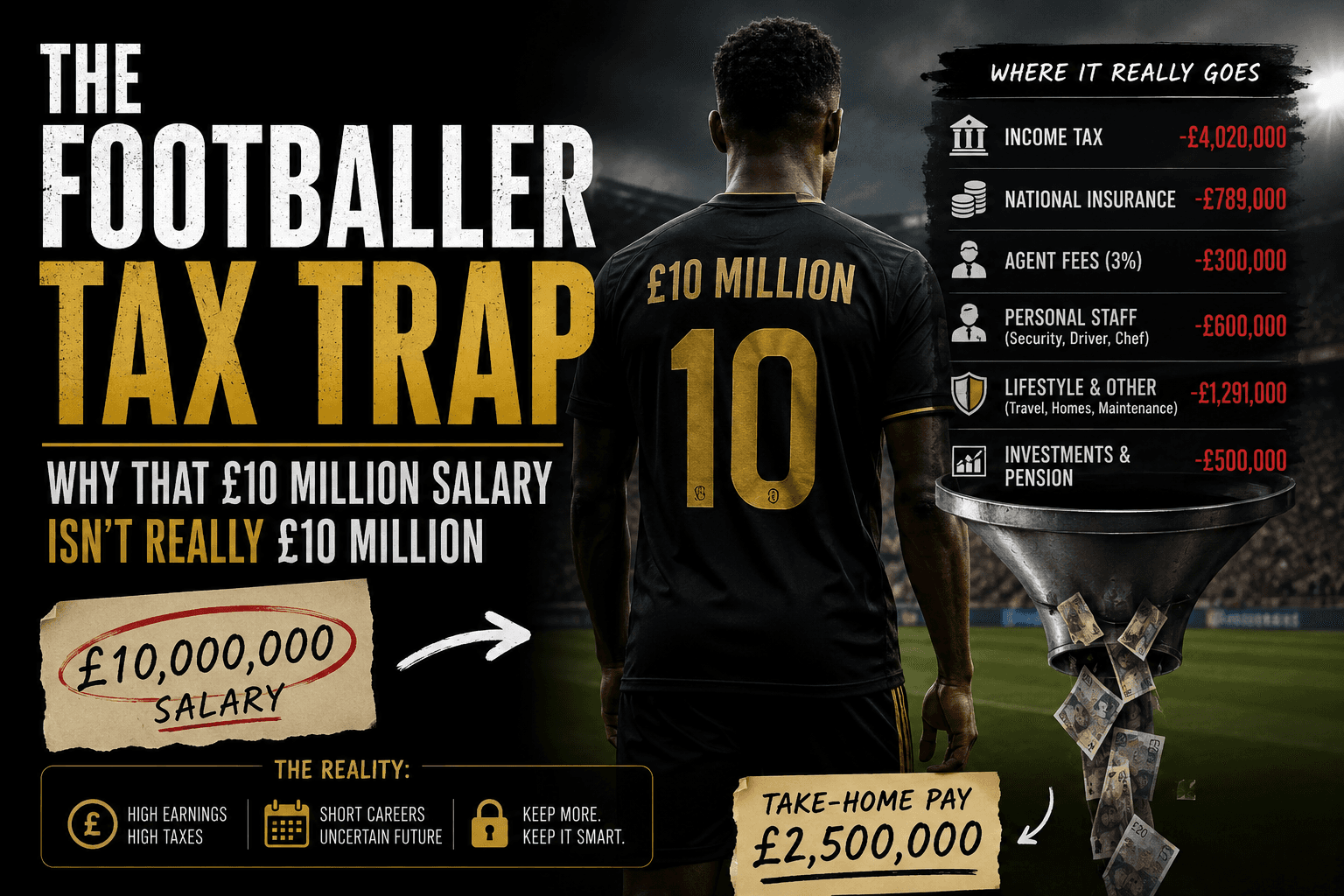
The Footballer Tax Trap: Why That £10 Million Salary Isn't Really £10 Million
Every time a footballer signs a new deal, headlines scream out massive salary figures. But almost none of that number ever touches the player's bank account in full. Here is what actually happens to a footballer's pay once the taxman gets involved.
The Footballer Tax Trap: Why That £10 Million Salary Isn't Really £10 Million
Every transfer window, the same headlines appear. A club signs a new star and reports claim the player will earn £10 million, £15 million, or even £20 million a year. Fans react in shock, debates start on social media, and somewhere in the comments someone says the player is "robbing" the club.
Here is what almost nobody mentions in those headlines. The player will never see most of that money.
Gross Salary Versus Take Home Pay
The number reported in the media is almost always the gross salary. That is the figure written into the contract before any deductions. What lands in the player's account is the net salary, and the gap between the two can be enormous depending on where the player is based.
Take a simple example. A player earning £10 million a year in a country with a 45 percent top tax rate would lose £4.5 million to tax, leaving £5.5 million as actual take home pay. That means nearly half of the headline figure disappears before the player ever sees it.
This is not a footballer specific issue. It is simply how income tax works for anyone earning at the very top of the scale. Footballers just happen to be some of the most visible high earners on the planet, which is why their numbers get so much attention.
Where Tax Rates Bite the Hardest
Tax rates for top earners vary significantly across Europe, and this directly affects how much of a player's salary they actually keep.
In the United Kingdom, top flight footballers effectively have no tax free personal allowance because of how the system tapers for high earners, meaning the majority of their income is taxed at the additional rate of 45 percent. According to payroll specialists PayFit, this means a player like Manchester City's Erling Haaland has an estimated annual tax bill exceeding £12 million.
Spain presents one of the toughest tax environments in football. According to the Tax Foundation, top income tax rates in Spain range from around 45.5 percent in Madrid to as high as 54 percent in regions like Valencia, where Villarreal are based. A breakdown by the CFE Tax Advisers Europe organisation confirms that tax resident players in La Liga pay between 43.5 percent and 52 percent depending on their region.
France sits at the very top of Europe's major football economies. Euronews reported in 2026 that France's top personal income tax rate stands at 55.4 percent, the highest among Europe's five largest economies, with the United Kingdom at 45 percent on the lower end of that group.
The Famous Cases
Some of the biggest names in football history have become household examples of just how much top earners contribute to national treasuries.
Lionel Messi was reported to have paid around £58 million in tax on an annual pay packet of £121 million during his time at Barcelona, a figure that made him Spain's biggest individual taxpayer for several years running, according to reporting compiled by The Business Standard.
Cristiano Ronaldo's move back to Real Madrid was also shaped heavily by Spain's tax rules. Reports at the time noted that Spain's top tax rate of 52 percent directly influenced contract negotiations, with the club structuring his pay so that his weekly take home figure stayed consistent despite the heavy tax burden.
The Beckham Law and Tax Friendly Schemes
Spain once offered a special tax regime for foreign workers, including footballers, known informally as the Beckham Law after David Beckham became one of its first high profile beneficiaries when he joined Real Madrid in 2003.
Under that scheme, qualifying non residents were taxed at a flat rate of around 24 percent instead of the standard top rate of over 50 percent. According to the Tax Foundation, this regime was eventually closed off to professional footballers from 2015 onward, though it remains available to other categories of skilled foreign workers.
Other countries have tried similar approaches. According to financial advisory firm Renn, Italy's impatriati regime currently allows newly arrived workers to have between 50 and 60 percent of their qualifying income exempt from standard income tax for five years, while Greece offers a 50 percent income exemption for seven years under its own scheme for new tax residents.
These regimes exist for a reason. Countries compete fiercely to attract the world's best talent, and tax policy has become one of the quieter but most powerful tools in that competition.
Why This Actually Affects Transfers
This is not just an accounting curiosity. Tax differences between countries can directly shape where players choose to play.
A study from the Tax Foundation looking at football taxation across Europe noted that highly skilled, well paid players tend to gravitate toward countries with lower personal income tax rates when given the choice. The same study pointed out that Spain's high tax rates, particularly in regions like Valencia at 54 percent compared to Madrid's lower regional rate, can put certain clubs at a real disadvantage when competing for the same players.
A separate analysis from the Fundacion Fide research group illustrated the gap starkly. A footballer earning 500,000 euros gross in Spain would lose around 235,000 euros to tax, while the same gross salary in Italy, France, or Germany would result in a tax bill below 200,000 euros.
When clubs are negotiating contracts worth tens of millions, these percentage differences translate into millions of euros that either go to the player or to the government, depending entirely on geography.
What This Means for Fans
The next time a transfer headline announces a jaw dropping salary figure, it helps to remember that the number rarely tells the full story. A reported £10 million deal in one country might leave a player with significantly more or less take home pay than the exact same gross figure in another country, purely because of where the contract is signed.
This also explains why some players seem to prioritise certain leagues or countries beyond just footballing reasons. Tax efficiency has quietly become part of how modern football contracts are negotiated, alongside wages, bonuses, and image rights.
Far from being a minor footnote, taxation has become one of the invisible forces shaping where the world's best players end up playing.
Quick Facts on Footballer Taxation
Top personal income tax rates for high earners currently stand at 45 percent in the United Kingdom, between 43.5 and 52 percent in Spain depending on the region, and 55.4 percent in France, according to data compiled by Euronews and the Tax Foundation.
Erling Haaland's estimated UK tax bill exceeds £12 million annually, according to PayFit.
Lionel Messi was Spain's top individual taxpayer for several consecutive years during his time at Barcelona, paying around £58 million in tax on annual earnings of £121 million.
Spain's Beckham Law once allowed foreign footballers to pay a flat 24 percent tax rate instead of the standard top rate, before professional footballers were excluded from the scheme in 2015.
Comments (0)
Leave a Comment
No comments yet. Be the first to share your thoughts!
Related News
 Sports

Never Miss a Story
Get the latest breaking news and exclusive content delivered straight to your inbox.