
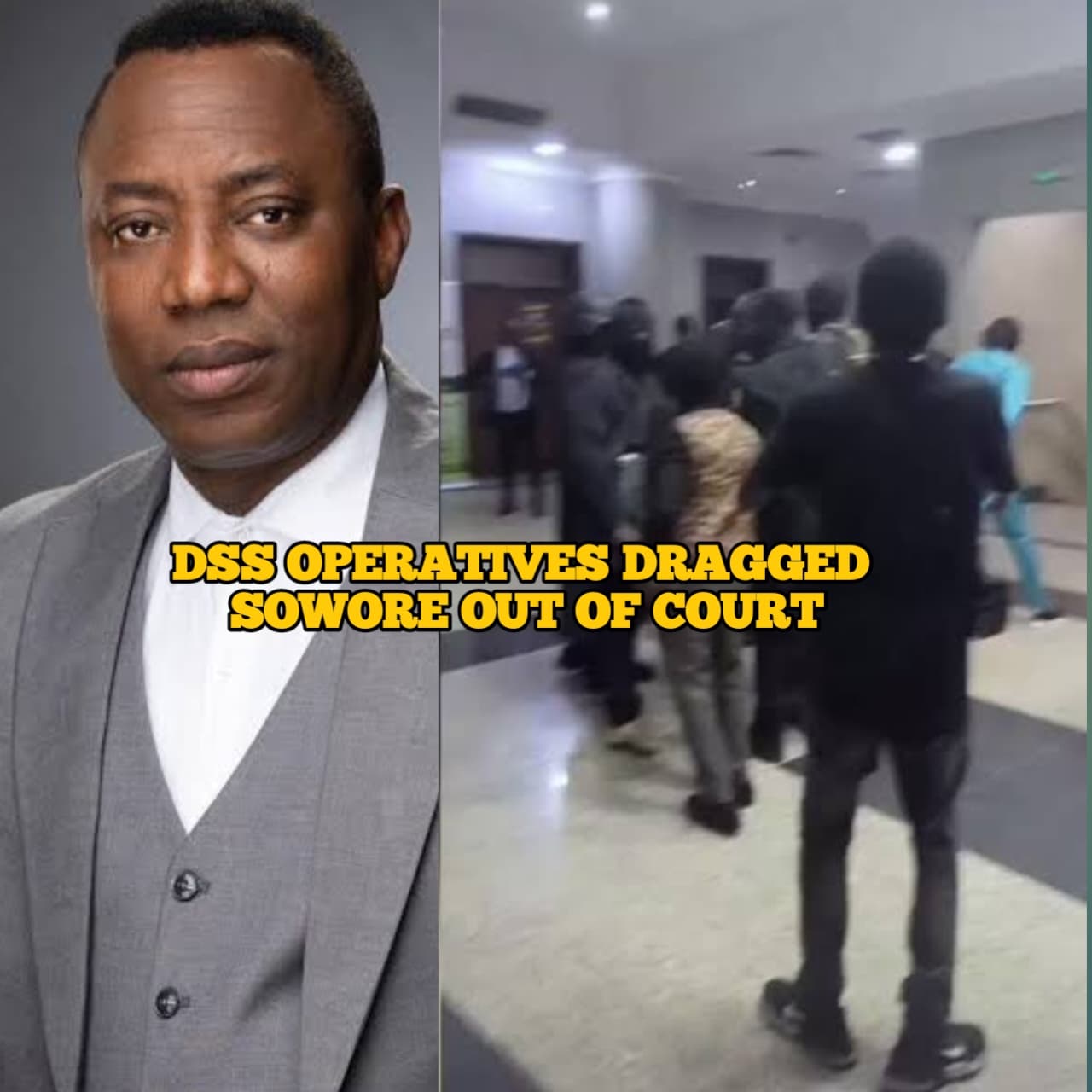
DSS Operatives Dragged Sowore Out of Court. He Is Now in Kuje Prison. And SERAP Wants Tinubu to Release Him Immediately.
Omoyele Sowore walked into the Federal High Court in Abuja on Monday morning with supporters carrying placards. He walked out in the custody of approximately ten armed DSS operatives who forcibly removed him from the court premises. Justice Mohammed Umar had just remanded him at Kuje Correctional Centre until Wednesday. SERAP demanded his immediate release. This is the full timeline of how Nigeria's most-arrested activist got here.
DSS Operatives Dragged Sowore Out of Court. He Is Now in Kuje Prison. And SERAP Wants Tinubu to Release Him Immediately.
Operatives of the Department of State Services on Monday reportedly arrested human rights activist and African Action Congress presidential candidate Omoyele Sowore within the court premises. The development came after a hearing before Justice Mohammed Umar of the Federal High Court in Abuja that lasted through the morning of June 22, 2026.
SaharaReporters observed that about ten armed DSS operatives, dressed in black, forcibly dragged Sowore out of the court premises despite protests from persons present.
He is currently at the Kuje Correctional Centre. He will remain there until Wednesday, June 24, 2026, when proceedings are scheduled to resume. He has not been convicted of anything. He maintains a plea of not guilty.
This is how it happened, from the beginning.
The Post That Started It All
The charges stem from posts published on Sowore's X and Facebook accounts in which he allegedly referred to President Bola Tinubu as a criminal.
The specific post that triggered the prosecution was made on August 25, 2025. Sowore had posted: "This criminal @officialABAT actually went to Brazil to state that there is NO MORE corruption under his regime in Nigeria. What audacity to lie shamelessly!"
The post was made in response to statements President Tinubu made during a trip to Brazil, in which he claimed his administration had ended corruption in Nigeria.
The DSS demanded that X Inc. and Meta Platforms Inc. ban Sowore's accounts and remove the posts. The security agency also wrote to Sowore directly, asking him to delete the posts from all platforms. He refused, citing his right to free speech.
On December 2, 2025, Sowore was arraigned before Justice Mohammed Umar on a two-count cybercrime charge. He pleaded not guilty. The charges allege offences under Sections 24(1)(b) and 24(2)(a), (b), and (c) of the Cybercrimes Prohibition, Prevention, Etc. Amendment Act of 2024. The prosecution argues that the statements were knowingly false and intentionally deployed to cause a breakdown of law and order in Nigeria and pose a threat to life.
Sowore's position throughout has been that calling the president a criminal is an expression of political opinion, not cyberstalking, and that the charges represent the criminalisation of free speech.
What Happened in Court: The Full Sequence
To understand Monday's arrest, the full sequence of events in the weeks before it matters.
In May 2026, Justice Umar rejected Sowore's application to have the charges dropped, ruling that the DSS had established a prima facie case and that Sowore was required to open his defence.
In early June 2026, following a judicial directive for daily trial hearings, Sowore's legal team withdrew from the case. He was left to represent himself, a development his supporters described as an attempt by the court to disadvantage him.
Sowore then filed a formal application seeking the disqualification of Justice Umar from the case, alleging a reasonable apprehension of bias and urging that the case be referred to the Chief Judge of the Federal High Court for reassignment to another judge.
On June 15, Sowore wrote to the court requesting an adjournment, asking for the ruling on his recusal application to be fixed for July or September 2026. The court did not grant the adjournment.
At the resumed proceedings on June 16, Sowore failed to appear. He sent a letter explaining that he had travelled to Lagos to search for lawyers to represent him. Following an application from the DSS, Justice Umar revoked the bail previously granted to Sowore and issued a bench warrant for his arrest.
The prosecution labelled Sowore's absence a delay tactic. Justice Umar agreed, holding that the defendant's failure to appear amounted to clear disobedience of the court's directive.
Sahara Reporters separately reported that former Inspector-General of Police Kayode Egbetokun had reached out to current Inspector-General Tunji Disu, as well as judicial and security officials, urging them to ensure that Sowore was taken into custody if he appeared in court on Monday. Sources said Egbetokun was angered that Sowore had not been arrested despite the bench warrant issued by Justice Umar. The Nigerian Police Force and DSS had not publicly confirmed or denied those reports as of the time of publication.
What Happened on Monday, June 22
Sowore arrived at the Federal High Court in Abuja on Monday morning accompanied by supporters and members of his group carrying placards, in defiance of the bench warrant.
At the hearing, he was represented by a new counsel, Senior Advocate of Nigeria Adeyinka Patrick Olumide-Fusika, who apologised to the court for Sowore's absence on June 16, explaining that he had instructed Sowore to travel to Lagos for consultations and proper briefing on the case.
The court considered the application but did not reinstate bail.
Justice Umar dismissed Sowore's application seeking the recusal of the presiding judge, ruling that the issues raised amounted to an afterthought and observing that Sowore had already taken active steps in the proceedings before raising the complaint, having participated in the trial up to the point where the prosecution closed its case and a no-case submission was filed and dismissed.
Justice Umar officially dismissed Sowore's motion seeking his disqualification over alleged bias. Following the arrest order, the court ordered Sowore to be remanded at Kuje Correctional Centre.
Then came the scene that went viral.
About ten armed DSS operatives dressed in black forcibly dragged Sowore out of the court premises despite protests from persons present. The operatives took him into custody.
Sowore will remain in custody until Wednesday, June 24, 2026, when legal proceedings are scheduled to resume.
What SERAP Said
The Socio-Economic Rights and Accountability Project, one of Nigeria's most active civil liberties organisations, issued a formal demand to the Tinubu administration on June 22 calling for Sowore's immediate release.
SERAP said the administration must end what it described as growing authoritarian practices, uphold the rule of law, and ensure respect for the human rights of everyone in Nigeria, including the rights to liberty, a fair trial, freedom of expression, freedom of association, and peaceful assembly.
SERAP also called on President Tinubu to publicly urge the DSS to uphold and ensure full respect for the rights of everyone in the country, including journalists, bloggers, human rights defenders, and activists.
The organisation called for a review of laws including the Official Secrets Act, the Criminal Code Act, and the Cybercrime Act, describing them as continuing to erode citizens' enjoyment of their human rights and media freedom.
The DSS and the Presidency had not publicly responded to SERAP's statement as of the time of publication.
The Specific Charges and the Law Being Used
The legal provision at the centre of this case is significant and contested.
The prosecution's case rests on Section 24 of the amended Cybercrimes Act of 2024. The prosecution argues that Sowore's online rhetoric was knowingly false and intentionally deployed to incite public disorder.
Section 24 of the Cybercrimes Act has been widely criticised by press freedom organisations, legal scholars, and civil liberties groups as being unconstitutionally vague and susceptible to use as a tool against critics of government. The law criminalises sending electronic messages that are "false" and "likely to cause breakdown of law and order," a standard that critics argue is so broad it could encompass almost any criticism of public officials.
The Committee to Protect Journalists, Reporters Without Borders, and the Clooney Foundation for Justice have all previously raised concerns about the use of this provision against journalists and activists in Nigeria. The Clooney Foundation's TrialWatch programme has previously monitored Sowore's earlier trials and found that charges against him appeared to have been brought because his political activities were at odds with the government's agenda.
Sowore's position remains that he stated a political opinion about a public official on a matter of clear public interest, and that no democratic society should criminalise that act regardless of how strongly the subject of that opinion objects.
Sowore's History of Arrests
Monday's remand to Kuje is not the first time Sowore has been put in custody.
He was first arrested in August 2019 by the DSS under President Muhammadu Buhari after calling for a revolution protest. He was held for months, released, and subsequently arrested again in the same courthouse where he had been freed. International pressure contributed to his eventual release.
In October 2025, he was arrested at the Federal High Court in Abuja during a protest and detained for several days.
On June 22, 2026, he was arrested again. This time inside a courtroom. By operatives who forcibly removed him from the premises.
He has been under continuous criminal proceedings since December 2025. He is currently in Kuje Correctional Centre. The next hearing is Wednesday.
What Comes Next
Proceedings are set to pick back up on Wednesday, June 24, as Sowore remains in custody. His new legal team, led by SAN Adeyinka Patrick Olumide-Fusika, will have two days to file any emergency bail application or other relief before the next scheduled hearing.
Whether Justice Umar reinstates bail on Wednesday, continues to remand Sowore, or takes any other course of action will determine whether the country's most prominent opposition activist spends more time in Kuje or returns to the streets.
The case against him, distilled to its essence, is this: a man called the president a criminal on social media. The government arrested him. He refused to delete the post. He spent months fighting in court. He missed a hearing. His bail was revoked. He was dragged from a courthouse by armed agents. And he is now in prison.
He has not been convicted of anything.
Comments (0)
Leave a Comment
No comments yet. Be the first to share your thoughts!
Related News

 Politics
Never Miss a Story
Get the latest breaking news and exclusive content delivered straight to your inbox.