
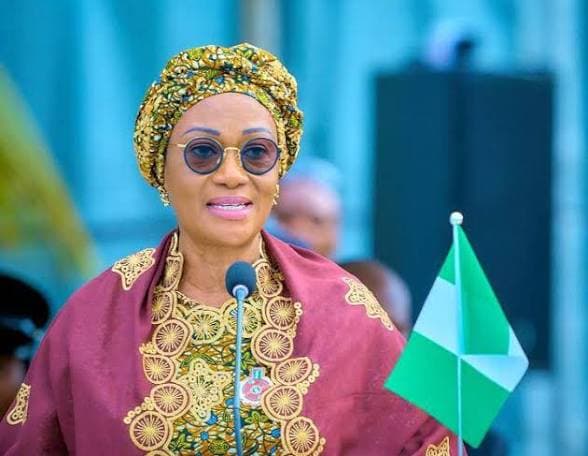
"To Start an Akara Business Doesn't Take a Lot of Money." The First Lady Said It. Nigeria Has Been Arguing Ever Since.
At the second-quarter meeting of the Renewed Hope Initiative in Abuja, First Lady Oluremi Tinubu advised Nigerians struggling with the economy to consider starting akara, roasted corn, or kuli-kuli businesses, saying "to start an akara business doesn't take a lot of money." A video of the comments went viral within 24 hours. The reactions have been as divided as Nigeria itself. Here is what she said, the context she said it in, and what both supporters and critics are saying.
"To Start an Akara Business Doesn't Take a Lot of Money." The First Lady Said It. Nigeria Has Been Arguing Ever Since.
First Lady Oluremi Tinubu has sparked widespread debate online after encouraging Nigerians to consider small-scale businesses such as selling akara, roasted corn, and kuli-kuli as a means of livelihood.
Tinubu made the remarks while speaking with journalists after the second-quarter meeting of the Renewed Hope Initiative alongside wives of state governors at the State House in Abuja on Wednesday. A video of her comments, later shared by News Channel 247 on Friday, quickly went viral on social media.
The video did not just go viral. It ignited a debate about economic hardship, government disconnect, dignity of labour, and what Nigerians in 2026 are actually entitled to expect from their leadership.
What She Said, in Full
The First Lady was speaking about the Renewed Hope Initiative, the social investment programme she leads. She explained that the programme provides grants, not loans, to vulnerable Nigerians to help them start businesses.
In the video trending online, Mrs Tinubu advised: "To start an akara business doesn't take a lot of money. To start roasting corn or kuli-kuli doesn't take much."
She added: "We didn't give them a loan, we gave them a grant. We have encouraged Nigerians as best as we could."
She also said: "So we've encouraged Nigerians as best as we could. What is within our hands, I have given, and I keep giving."
She went further in the same address, speaking about the Renewed Hope Initiative's broader interventions. "I remember giving for TB. When I heard there were so many TB cases, I gave N2 billion. To breast cancer, I gave a billion. For food malnutrition, I gave half a billion," she stated.
She also acknowledged the economic difficulty Nigerians are experiencing. "The narrative has really changed, has changed to challenge the average man, whereas the average man is supposed to have hope," she said.
At the same meeting, she addressed the food security crisis directly. She declared that "no child should go hungry" and announced that the National Food Bank Programme, launched in Abuja on February 17, 2026, had already expanded to the North-East and would soon cover the North-West and South-West.
She also told the gathering that she personally maintains a garden at the State House for food security purposes, saying: "Because of food security, I even happen to have a garden. I have a garden that can produce okra that I can also give away. So every time I go there to harvest, I always have to give to my staff."
Why the Reaction Has Been So Strong
The remarks about akara, roasted corn, and kuli-kuli did not land in a political vacuum. They arrived in the middle of one of the most economically painful periods in Nigerian recent history.
The World Bank reported in 2025 that 63% of Nigerians now live in poverty, up from 56% when President Tinubu took office in May 2023. That is approximately 20 million more Nigerians falling below the poverty line in two years. Food prices have nearly doubled in many markets since the removal of the fuel subsidy in May 2023. A bag of rice in several markets costs above N80,000. Transport fares have multiplied. The minimum wage is N70,000 a month.
In that context, a First Lady advising struggling Nigerians to sell akara struck a significant portion of the country's online population as a statement that had missed the scale of what people were experiencing.
An X user, @ADCVanguard_, described the remarks as evidence of "how disconnected Nigeria's ruling class has become from the reality of ordinary citizens."
Another user wrote: "Nigerians from different tribes and religions, this is you guys' fault. You see what a First Lady is telling your mothers, wives, and daughters. She and Tinubu are going to increase your suffering seven times if you don't vote them out."
Nefertiti, @firstladyship, wrote: "Nigerians are in big trouble. There is fire on the mountain but the people are tired of running."
What Supporters of the Statement Said
The reaction was not one-sided. A meaningful segment of Nigerian social media pushed back on the backlash.
A netizen identified as @Akikanju defended the First Lady's remarks, arguing: "Akara business is one of the most lucrative businesses in Nigeria. Start-up cost is the lowest and the profit margin is over 50 per cent. Akara sellers sent many kids like you to universities, built houses, bought cars, and provided a good quality of life. Sadly, many Nigerian youths lack the mental and physical capacity to explore and engage the immense opportunities around them. You are doing yourselves a disservice, not the First Lady."
Another commentator, @TossynBankz_, offered a different framing: "Nobody is mocking akara, roasted corn, or kuli-kuli." He argued that the anger was more accurately directed at the economic conditions that made the First Lady's suggestion feel inadequate, not at the dignity of the businesses themselves.
User @PemiOladapo argued that local snack businesses could grow into successful ventures, while @ireteeh contrasted the initiative with private-sector empowerment efforts.
The distinction being drawn by the calmer voices in the debate is a real one. Akara sellers do run successful businesses. Millions of Nigerians have built livelihoods through small-scale food trade. The question generating anger is not whether those businesses are legitimate. It is whether the First Lady of a nation in an economic crisis is meeting the moment by pointing people toward them.
The Broader Context: What the RHI Has Done
It is worth separating the viral quote from the broader record of the Renewed Hope Initiative, because conflating the two produces an incomplete picture.
The RHI has expanded food banks to primary healthcare centres, launched a National Food Bank Programme that is reaching the most food-insecure regions of the country, and Mrs Tinubu has spoken publicly about child malnutrition, tuberculosis and breast cancer funding in terms of concrete naira amounts.
On June 26, she commissioned the new national headquarters of the Nigerian Red Cross Society in Gwarinpa, Abuja, where she was recently invested as the first Grand Matron of the society, and donated N100 million to support the organisation's staff and volunteers.
These are real activities. Whether the scale of those activities is proportionate to the scale of Nigeria's social and economic crisis is a legitimate question. But dismissing the RHI's record entirely because of the viral clip produces a portrait that the record does not support.
What is also true is that the First Lady's personal donations to health causes, and the initiative's grant programmes, exist in a country where 63% of people are in poverty and where the policies of the same administration have contributed significantly to that number. The co-existence of personal philanthropy and structural policy consequences is the tension at the heart of the debate.
The "Leaders Respected Abroad" Statement That Also Went Viral
This is not the first Remi Tinubu statement to generate national debate in 2026.
In February, following her attendance at the US National Prayer Breakfast in Washington DC, where President Donald Trump acknowledged her publicly as a leader of one of Nigeria's largest churches, the First Lady posted a statement that also went viral.
"Most of our leaders are highly respected and honoured abroad, yet many Nigerians fail to value what they have because of hatred and the narratives planted in their minds by political paymasters, which have also hardened their hearts," she said.
She urged Nigerians to work with their leaders rather than seek to undermine them, and said: "Nigeria is built on love, unity, and collective effort toward shared success. Let us come together to support our respected leaders and work hand in hand with them to make our country great."
That statement was also met with divided reactions, with supporters describing it as a call for national unity and critics arguing it dismissed legitimate grievances as politically manufactured.
The akara statement is the more visceral controversy because it touches something more immediate: food, survival, and what it costs to live in Nigeria today.
What the Statement Tells Us
Statements like this one are rarely just about what was said. They are about what people were already feeling before the words arrived.
In a different economic moment, a First Lady encouraging Nigerians to start small businesses, providing grants through a social initiative, and personally visiting food banks, hospitals, and NGOs would be reported as active public service.
In a moment where 63% of Nigerians live in poverty, where the same administration's policies removed subsidies that the poor depended on, where petrol costs above N1,000 per litre and a bag of rice costs N80,000, where children are being abducted from schools and teachers are on strike, the same words land differently.
The First Lady meant to encourage. A significant portion of Nigeria heard something else.
Both things can be true at the same time.
Comments (0)
Leave a Comment
No comments yet. Be the first to share your thoughts!
Related News
 Politics
Never Miss a Story
Get the latest breaking news and exclusive content delivered straight to your inbox.